
Table of Contents
In the world of commercial cannabis cultivation, some of the most expensive mistakes happen long before the first clone takes root. They happen in Excel spreadsheets and business plans, where deceptively simple math can derail your entire operation. Understanding the Calendar Trap is essential to avoid these pitfalls.
You’ve likely seen this calculation before: take 365 days in a year, divide by an average flowering cycle of 62 days, and you’ll get 5.5 harvests annually—even more if you’re really ambitious. The math looks solid on paper. Unfortunately, paper is a lot more forgiving than a commercial cultivation facility.
This oversimplified approach to harvest planning ignores the complex reality of commercial cannabis operations. Your flowering rooms don’t exist in isolation—they’re part of an ecosystem where every component must work in harmony. If one element was never sized properly or falls out of sync, the entire operation feels the impact.
The Bottleneck Nobody Plans For
Consider your post-harvest infrastructure. Without adequate drying capacity or a dedicated harvest team and properly equipped harvest station, you’ll face a critical bottleneck. Your perfectly planned 62-day cycle suddenly gets thrown off, and plants have to stay in the ground waiting for drying space to open up. Alternatively, you find yourself rushing the dry, compromising product quality to maintain the schedule. Either way, that theoretical 5.5 harvests starts looking increasingly unrealistic.
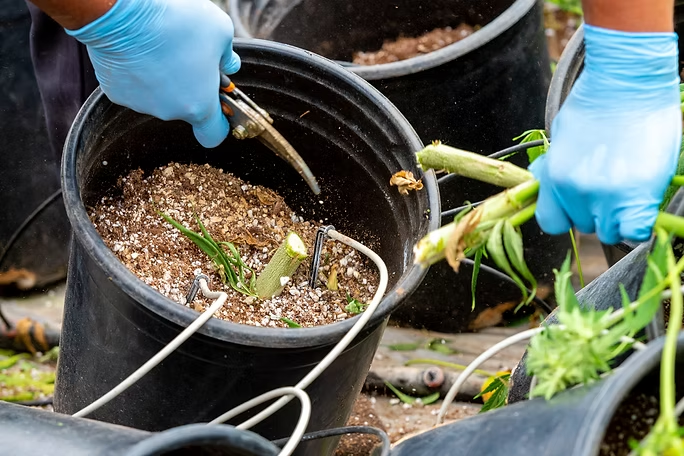
Then there’s the pipeline problem. Those flower rooms need a constant supply of healthy, vigorous plants ready to go. Every successful run depends on properly vegged teens at the right stage of development, supported by consistent mother stock maintenance. Miss one beat in this carefully choreographed sequence, and your “perfect” schedule begins to crumble.
The Hidden Time Between Cycles
What about the time requirements between cycles? Each room flip demands thorough sanitization, preventive maintenance checks, and system repairs. Rushing these critical processes to maintain an aggressive schedule is a recipe for disaster. Prevention is always cheaper than crisis management in commercial cultivation. I’ve seen repairs skipped as a team rushes to fill the next greenhouse, and those shortcuts have a way of showing up as full-blown production failures weeks later.
Perhaps the most overlooked factor: nature doesn’t read your calendar. Plants respond to environmental conditions, genetic expressions, and stress factors—not spreadsheet formulas. A strain that typically flowers in 62 days might need 65 or 66 under slightly different conditions. Multiply those small variations across multiple rooms and cycles, and your annual projections need serious adjustment.
The Resource Reality
That aggressive 5.5 harvest schedule assumes full staffing year-round, no budget constraints, and perfect execution every time. In real cultivation operations, these assumptions never hold. Labor shortages, equipment maintenance, and unexpected challenges are part of the business. Planning without accounting for these variables is planning to fail.
The most expensive calculator in commercial cannabis cultivation is the one that ignores operational realities. Success isn’t measured by maximizing harvest numbers—it’s about optimizing your entire operation for sustainable, high-quality production.
RELATED READING
TLDR: Flower math doesn’t matter. Dry room and nursery throughput does. Don’t operate at redline every day.
When you’re ready to move beyond simple calendar math and create harvest schedules that work with your facility’s actual capabilities, we’re here to help.
Cannabis Wise Guys: Bringing engineering precision to commercial cultivation.